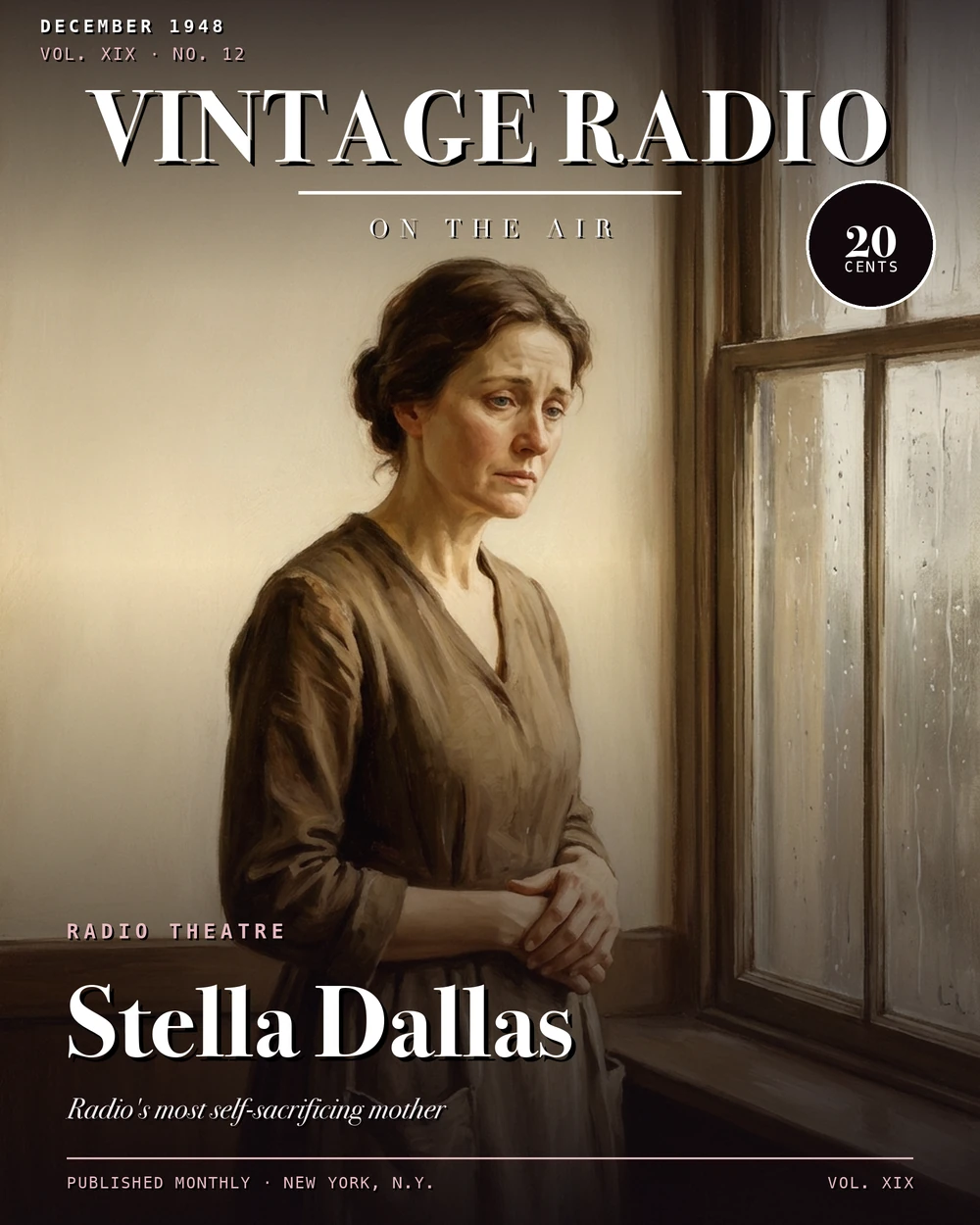
Stella Dallas
The Story That Wouldn't Let Go
When Stella Dallas premiered on WEAF in New York on October 25, 1937, it came pre-loaded with recognition. The 1937 Barbara Stanwyck film had just opened at Radio City Music Hall, Frank S. Nugent had reviewed it in the New York Times, and audiences already knew the outline: a rough-edged woman from the wrong side of the tracks sacrifices everything so her daughter can have the life she never could. The radio serial positioned itself as a continuation of that story — "the true-to-life sequel, as written by us, to the world-famous drama of mother love and sacrifice." Later it was rebilled as "the later life of Stella Dallas," which was the framing that stuck.
The show moved to NBC network broadcasting on June 6, 1938, and ran there until December 23, 1955 — nearly eighteen years of fifteen-minute weekday episodes, airing at 4:15 in the afternoon. Sterling Drugs carried it for most of that run, with Phillips Milk of Magnesia and Double Danderine among the advertised products. In Memphis, the show ran on WMC at 3:15, slotted right after Backstage Wife and just before Lorenzo Jones — three back-to-back slices of the same neighborhood of emotional drama.
The novel behind all of it was by Olive Higgins Prouty, published in full by Houghton Mifflin in 1923 after appearing serially in The American Magazine the previous year. Prouty reportedly was not pleased with what radio did to her characters, and had not approved the sale of the broadcast rights — a sore point that followed the show throughout its run.
How the Story Worked
The radio serial's opening narration laid out the premise plainly: "We give you now Stella Dallas, a continuation on the air of the true-to-life story of mother love and sacrifice, in which Stella Dallas saw her own beloved daughter, Laurel, marry into wealth and society and, realizing the differences in their tastes and worlds, went out of Laurel's life."
Stella herself was a woman born of poor parents who had worked in the garment-district sweatshops of Boston before meeting Stephen Dallas, a man of wealth and position captivated by her energy. She left their daughter Laurel — "Lolly-baby," she called her — with Stephen, believing the Dallas money would give the girl advantages Stella couldn't. Laurel grew up, fell in love with Dick Grosvenor, a young banker whose shrewish mother wanted nothing to do with Stella, and that class divide became one of the show's permanent engines of tension.
Around Stella orbited a cast of regulars: Minnie Grady, the sharp-tongued Irishwoman who had been her friend since the Boston sweatshop days and whose Massachusetts farm served as Stella's retreat when things got bad; Ed Munn, a loud, boisterous, free-spending fellow who proposed to Stella repeatedly and was turned down each time, good-naturedly; and Bob James, a much younger man from a poverty-stricken background whom Stella regarded as a soulmate, at one point offering to pay his way through law school before he became innocently caught up in a gangster's murder.
The plots could travel far. One storyline sent Stella to Egypt in pursuit of a character named Ahmed and landed her in a tense sequence at the bottom of the Suez Canal, in a submarine. Another had her braving the deserts and jungles of Africa. Later in the run, a villain named Raymond Wylie — Stephen Dallas's business partner — attempted to kill them both. And at some point Stella found herself falsely accused of stealing an Egyptian mummy. The show was sometimes described as perhaps the most excruciating melodrama on radio, a distinction it shared in family with two other Frank and Anne Hummert productions — Backstage Wife and The Romance of Helen Trent.
The Voice of Stella
Anne Elstner played Stella Dallas for the entire run, missing only one performance across eighteen years — commuting daily from her home in Stockton, New Jersey to do it. She had been in radio since 1923, which meant she came to the role with real seasoned skill, but the role is what defined her career.
She won the part partly because of her voice. A husky quality in it reminded the producers, at least vaguely, of Barbara Stanwyck's voice — a useful echo given the show's direct connection to Stanwyck's film. According to Richard Lamparski, Elstner auditioned alongside twenty-five other actresses. What she brought to Stella was consistent across nearly two decades: a character who clipped her g's, used double negatives, and said "ain't" without apology — a woman whose grammar announced her origins every time she opened her mouth, even as the plots sent her to Egypt and Africa and back again.
Elstner's own biography had its own texture. Born in Lake Charles, Louisiana on January 22, 1899, she was the youngest of eight children. Her family moved often for her father's accounting work. She attended Senn High School in Chicago for a year before transferring to Mount de Chantal Visitation Academy in Wheeling, West Virginia, where her mother had also gone. After settling in New York, she enrolled at the American Academy of Dramatic Arts, worked an assortment of jobs, and made her Broadway break in the 1923 production of Sun-Up, where a Wall Street Journal review on July 27, 1923, commended her "for her faithful delineation of the unattractive but moving mountain girl."
Her pre-Stella radio career was extensive. She had played Ma Gibson on NBC's The Gibson Family, Martha Booth on the CBS soap Trouble House, and Mary Weston on The Wilderness Road, also for CBS. At her peak she was performing on as many as ten different radio programs in a single day. A 1976 interview found her estimating more than 2,000 radio programs over her career, and she added that radio after stage work was a genuine adjustment: "you had to do it all with your voice."
The detail Lamparski recorded about her and the Stanwyck film is worth noting. Elstner played Stella for eighteen years without ever having read Prouty's novel or seen either of the two film versions. When the series ended, she finally watched the Stanwyck picture — and left the theater in tears.
After the show ended, Elstner and her husband Jack Matthews, a former FBI agent, ran a restaurant in Lambertville, New Jersey that they had opened in 1953 while the show was still on the air. With permission from the producers, she renamed it "Stella Dallas' Rivers Edge Restaurant." Fans made a point of visiting, and Elstner could be coaxed into performing "Lolly-baby" dialogue for the customers. The restaurant operated until 1973. She was later inducted into the first class of honorees at the National Broadcasters Hall of Fame, alongside Arthur Godfrey among the twenty-one members. She died of a stroke on January 29, 1981, at Doylestown Hospital in Pennsylvania.
The Rest of the Cast
The role of Laurel passed from Joy Hathaway in the late 1930s to Vivian Smolen, who held it for most of the series' long run. Smolen, born in New York City on March 7, 1916, had started in radio as a schoolgirl, winning a part on The Children's Hour in New York for $2 per program. By the time she graduated from James Madison High School in Brooklyn and attended Brooklyn College, radio was her profession. She joined Stella Dallas in 1941, and the role helped her land the lead on Our Gal Sunday in 1946, which she played until 1959 — both serials running concurrently. She was matter-of-fact about the workload: "It wasn't uncommon to have two big parts at once. I did many parts on many radio programs all the time."
Other cast members shifted over the years, as was typical in long-running serials. Stephen Dallas was played by Leo McCabe and also by Arthur Hughes and Frederick Tozere. Dick Grosvenor, Laurel's banker husband, passed among Carleton Young, Macdonald Carey, Spencer Bentley, George Lambert, and Michael Fitzmaurice. Grace Valentine played Minnie Grady. Helen Claire played Ada Dexter, described as a wealthy but mentally unstable character. Arthur Vinton played Ed Munn; Arnold Moss played Ahmed. The announcing duties were handled at various times by Ford Bond, Frank Gallop, Howard Claney, Jimmy Wallington, Jack Costello, and Roger Krupp. Richard Leibert served as organist throughout.
Dialogue was written by Helen Walpole under Anne Hummert's direction — the standard Hummert factory arrangement. Norman Sweetser, Richard Leonard, and Ernest Ricca directed at various points. The show used "Memories" and "The Old Refrain" as concurrent themes around 1940, and settled on "How Can I Leave Thee" for most of its run.
What Came Before and After
The radio serial existed inside a larger cultural life that Stella Dallas had developed across decades. The first film adaptation came in 1925 — a silent picture produced by Samuel Goldwyn, directed by Henry King, with Belle Bennett as Stella, Ronald Colman as Stephen, Lois Moran as Laurel, and Douglas Fairbanks Jr. as Richard Grosvenor. Goldwyn had bought the screen rights to Prouty's novel for $15,000, and the film became his highest-grossing release to date.
The 1937 sound version, directed by King Vidor and produced by Goldwyn, starred Stanwyck alongside John Boles as Stephen and Anne Shirley as Laurel, with Alan Hale as Ed Munn. At the 10th Academy Awards, Stanwyck received her first career Best Actress nomination for the role — she lost to Luise Rainer for The Good Earth — and Shirley was nominated for Best Supporting Actress. The film's music was composed by Alfred Newman.
Between the films, Prouty's novel had also been staged. A 1924 theatrical adaptation, with a script by Gertrude Purcell and Harry Wagstaff Gribble, starred Mrs. Leslie Carter and, in an early role, Edward G. Robinson.
In 1990, a third film version — titled simply Stella and directed by John Erman — came out through Touchstone Pictures, with Bette Midler in the lead, Trini Alvarado as her daughter (renamed Jenny), Stephen Collins as Stephen, and Marsha Mason in the cast. Ben Stiller and Eileen Brennan appeared in supporting roles. Midler received a Razzie Award nomination as Worst Actress of 1990 for her performance.
Prouty herself led a life of some consequence. A 1904 Smith College graduate who wrote ten novels, she endowed a scholarship at Smith whose most famous recipient was the poet Sylvia Plath. Prouty financially supported Plath through psychiatric treatment at McLean Hospital and stayed close to her until Plath's death in February 1963. Scholars have generally held that Plath based the character Philomena Guinea in The Bell Jar on Prouty.
Only thirteen known recordings of Stella Dallas survive, amounting to roughly two hours and forty-eight minutes of audio — a small fraction of a run that stretched across eighteen years and thousands of episodes.